
Reading & Listening Recommendations: Hispanic/Latine Heritage Month
By Ciara Kuldinow, Donor Relations Manager
To honor and celebrate Hispanic/Latine Heritage Month (Sept 15- Oct 15) I’m offering more book recommendations from the food bank team along with some other cool things to read, check out, and ponder!
I’m happy to be given this opportunity while Gypsy juggles our communications for the winter season and going on a writer’s retreat in Spain. 😊
I love fiction, romance, and adventure. Some of the best poetry I’ve read (not that I’ve read a ton) have been from Latin American writers. I’ll be adding a few titles from my ‘Want to Read’ list and some honorable mentions at the bottom.
The Ballard Food Bank book club has been reading Solito by Javier Zamora, a telling of young Zamora’s arduous emigration from his home in El Salvador to the U.S. where his parents wait for him. Check out this book review by Gabino Iglesias: https://www.npr.org/2022/09/29/1125275405/javier-zamora-solito-is-a-personal-story-of-immigration-that-is-also-universal
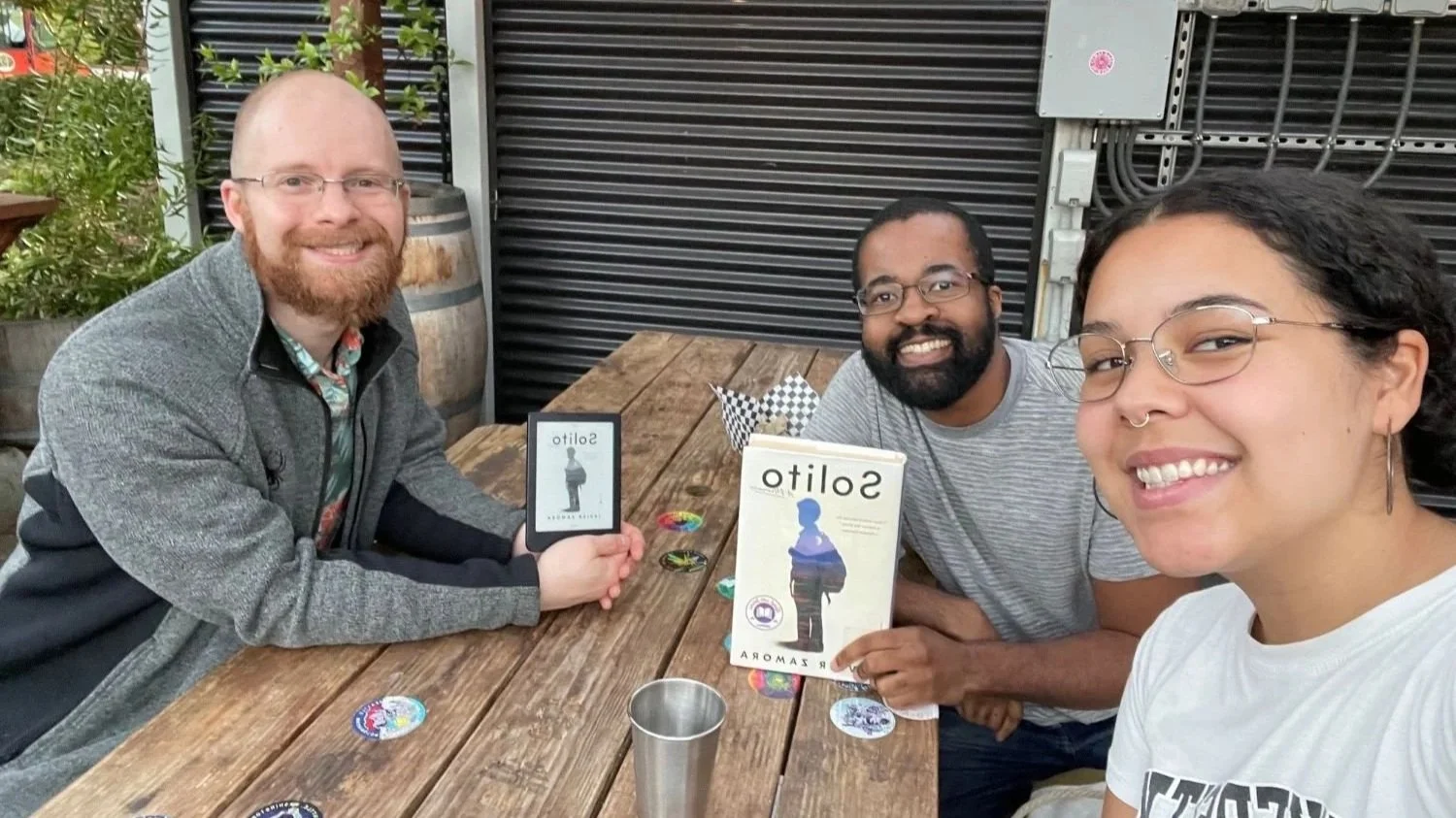
Staff and members of the Ballard Food Bank book club reading Solito
I read about a new recipe our Kindness Café team used and scaled to feed about 700 guests in our July food bank staff report. The recipe is Claudette Zepeda’s frijoles rancheros from her new cookbook: Cooking the Borderlands: Spice and Smoke Between Mexico and the States. “The dish was a hit with the people we served, and the social media post documenting the collaboration was well received by our online community, helping showcase the creativity and care that goes into every meal we make.” - Senior Program Manager & Executive Chef, Nissa.
Staff Recommendations:
Gypsy’s: Gods of Jade and Shadow by Silvia Moreno-Garcia
“Moreno-Garcia’s novels span so many different genres. My introduction was the delightful and creepy Mexican Gothic. Taking a very different paces and tone, the historical fantasy adventure Gods of Jade and Shadow takes a young woman on a wild journey across 1920s Mexico (and beyond) with a Mayan death god. I enjoyed the folklore, rich character development, and historical details woven throughout.”
Josue’s currently reading:
Chancla: Healing Our Families, Ourselves, and Our Culture through Nonviolent Parenting, by Leslie Priscilla.
The Undocumented Americans, by Karla Cornejo Villavicencio.
While gathering recommendations and just looking around for inspiration, I came across a colleague reposting an article about Alfredo Jaar’s 1987 art installation, A Logo for America. Jaar is a Chilean architect and artist whose work often comments on socio-political issues. A Logo for America was installed in Times Square “with the message “This Is Not America” superimposed on a map of the United States, followed by an image of the US flag with the text, “This Is Not America’s Flag.” Next, the “R” in America shifted into a dancing map of South, Central, and North America.” The article has a paywall after a certain point but you can still read about Jaar’s inspiration for the piece and it even includes a video of the installation back in 87’.
Read it here: https://hyperallergic.com/alfredo-jaar-is-still-trying-to-change-the-world/
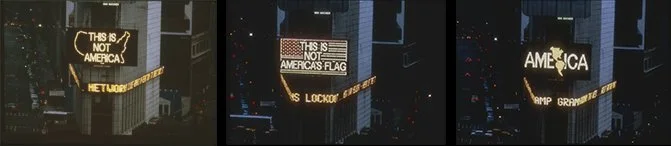
Image found online of Alfredo Jaar’s 1987 Installation, A Logo for America
The article (what I could read of it) activated me, excited me; because I love art, and because I was born and raised in the U.S. with our colonial education and am used to our colonizer language of taking and not sharing ownership of ‘America’. Having a Peruvian grandmother doesn’t help me escape from what I was grown to view as ‘America’.
Before I move on, I’ll plug Jaar’s son, Nicolas Jaar, a musician who makes some great music, often under the alias, Against All Logic. Here is one of his songs on his first album, 2012-2017, that I enjoy: Know You
And here is something I was happy to read on Nico Jaar’s Wikipedia: “Jaar made two songs featuring his vocals in Spanish, "Mi Mujer" and "El Bandido", which he did not originally intend to release as they were made as jokes to make his mother laugh and dance. However, he later chose to release them in 2010 in response to noticing a trend of non-Latin DJs sampling Latin American music without compensation.”
Back to father Jaar and his work; A Logo for America is overt with admonishment and I’m glad for it. It reminded me of Bad Bunny’s halftime show at the last super bowl. Seeing so many flags together on the field while the country watched on and heard loud and clear: this is America, still gives me goose bumps when I think about it. I’m grateful I found a blog post that dives into the meaning of the show from writer, speaker, and educator, Dāli Rivera. Her post, When Bad Bunny Made Us Feel Seen: A Love Letter to Latino Identity, breaks down the symbolism behind Bad Bunny’s performance and underlines the importance of representation and pride for Latine Heritage.
Some cool events in Seattle to check out:
Thursday, October 8: Mexican Muralism and Networks of Solidarity: "The Struggle Against Racial Discrimination" in Seattle and Beyond. This conversation situates Pablo O Higgins' 1945 mural, currently on display at the University of Washington, in the larger context of mural making and international organizing to explore the conditions and contradictions that conspired to make this form of expression a radical, if imperfect, tool for social change.
Friday, October 9: Fabricating the Global Tropics: A Talk by Joiri Minaya. Join artist Joiri Minaya for Fabricating the Global Tropics, a talk about textiles, place, identity, and the fantasy realm for the “exotic” that extends from the Caribbean to the Pacific. This public talk is one of two keynote lectures for the 7th Triennial Conference of the Association for Latin American Art, Reclamations: The Afro-Asian-Native Turn in the Arts of Latin America, presented in conjunction with her current exhibition Joiri Minaya: To Hell With Hibiscus.
And now, for my recommendations!
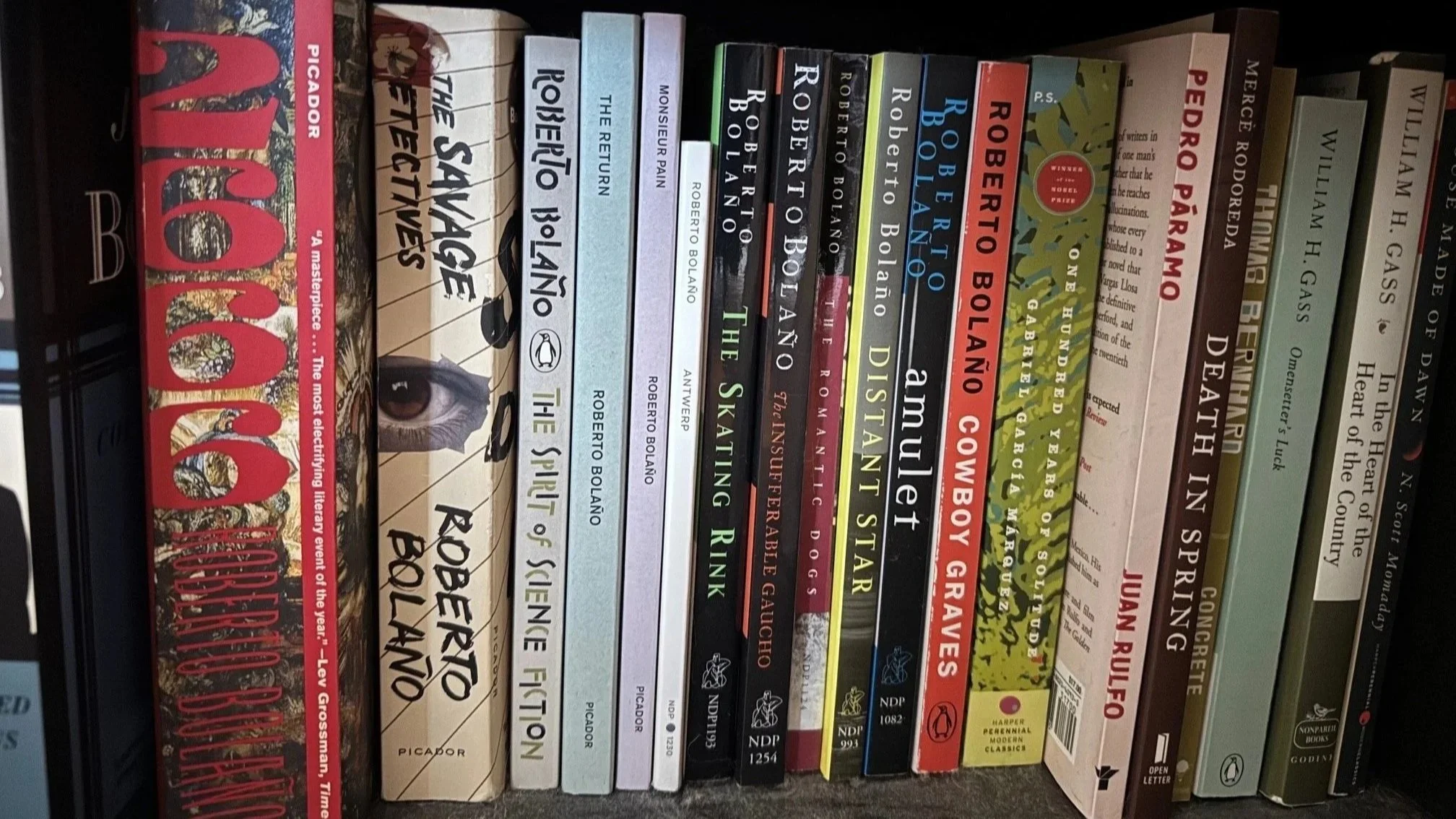
Ciara’s bookshelf
The Savage Detectives (Los Detectives Salvajes), by Roberto Bolaño. I have 12 Bolaño books on my bookshelf, which should tell you I really like his work (as does my fiancé who introduced me to his writing). I started my Bolaño journey by reading some of his earliest work, a prose poetry collection called Antwerp. After reading that and Cowboy Graves: Three Novellas, I dove into Savage Detectives and was not disappointed. You could see it as a coming-of-age story, where you find friends along the way, in the simplest terms. It takes little time to connect with each character as you travel along with them, going backwards and forwards in time, across many homes and countries, starting and ending in Mexico with travels to Europe and beyond filling the middle. Hilarious, sweet, dark, and thought provoking. I loved this sentence from Goodreads: “Roberto Bolaño traces the hidden connection between literature and violence in a world where national boundaries are fluid and death lurks in the shadow of the avant-garde.”
The Library of Babel, by Jorge Luis Borges. This short story is about a world that is just one huge library. It’s available to read for free on multiple sites and I highly recommend it, especially if you read Piranesi by Susanna Clark (The Library of Babel is a fraction of the length of Piranesi and way better in my opinion). Written in 1941, The Library of Babel is part of a collection of stories written in the 40’s and 50’s, called Ficciones, which I will read eventually. Borges’ style is saying more with less, keeping it mysterious, magical, and unnerving. He was highly influential to other writers and played a major role in the literary magical realist movement, a movement that revolves around contemporary Latin American fiction.
Pedro Páramo, by Juan Rulfo. This is one of the most surreal books I’ve ever read and is a pinnacle example of magical realism. Rather than writing reviews in Goodreads, I like to save prose that hit hard. Here is one I saved for this story: “First light was still a long way off. The sky was filled with stars, fat ones, swollen by the long night. The moon had come out for a short while, before disappearing again. It was one of those sorrowful moons that no one gazes at, no one notices. It had hung there for a time, disfigured, giving off no light, before rushing to hide behind the hills.” The imagery, the longing for the day!
In talking with my fiancé about writing this blog, he and I noticed a gap in my reading recs! Here are some contemporary stories from women I haven’t read yet but have heard great things about:
Hurricane Season, by Fernanda Melchor
House of the Spirits, by Isabel Allende
Seeing Red, by Lina Meruane
Honorable mention: One Hundred Years of Solitude, by Gabriel García Márquez. Most people start here when exploring magical realism. I couldn’t read past the first 50 pages but will pick it up and try again someday. Don’t let my failure hinder you; the writing is wonderful!
And below is a short list of books, mostly poetry, that I plan to read soon:
Ghosts, by César Aira.
Fog at Noon, by Tomás González.
Residence on Earth, by Pablo Neruda. (Entire book included in the link. Internet Archive is awesome!)
Further Resources from Local Libraries:
Latine Heritage Month Reads | King County Library System
Hispanic Heritage Month 2026: Recent Fiction for Adults | Seattle Public Library