
Reading Recommendations: Disability Pride
By Gypsy Walukones, Senior Communications Manager
July is Disability Pride Month. With a recent memo from the DOJ arguing that states are not required to provide in-home or community-based care to support people with disabilities - along with other attempts by the federal administration to dismiss and dehumanize so many of our neighbors - we’re highlighting Disability Pride Month through reading recommendations and other resources.
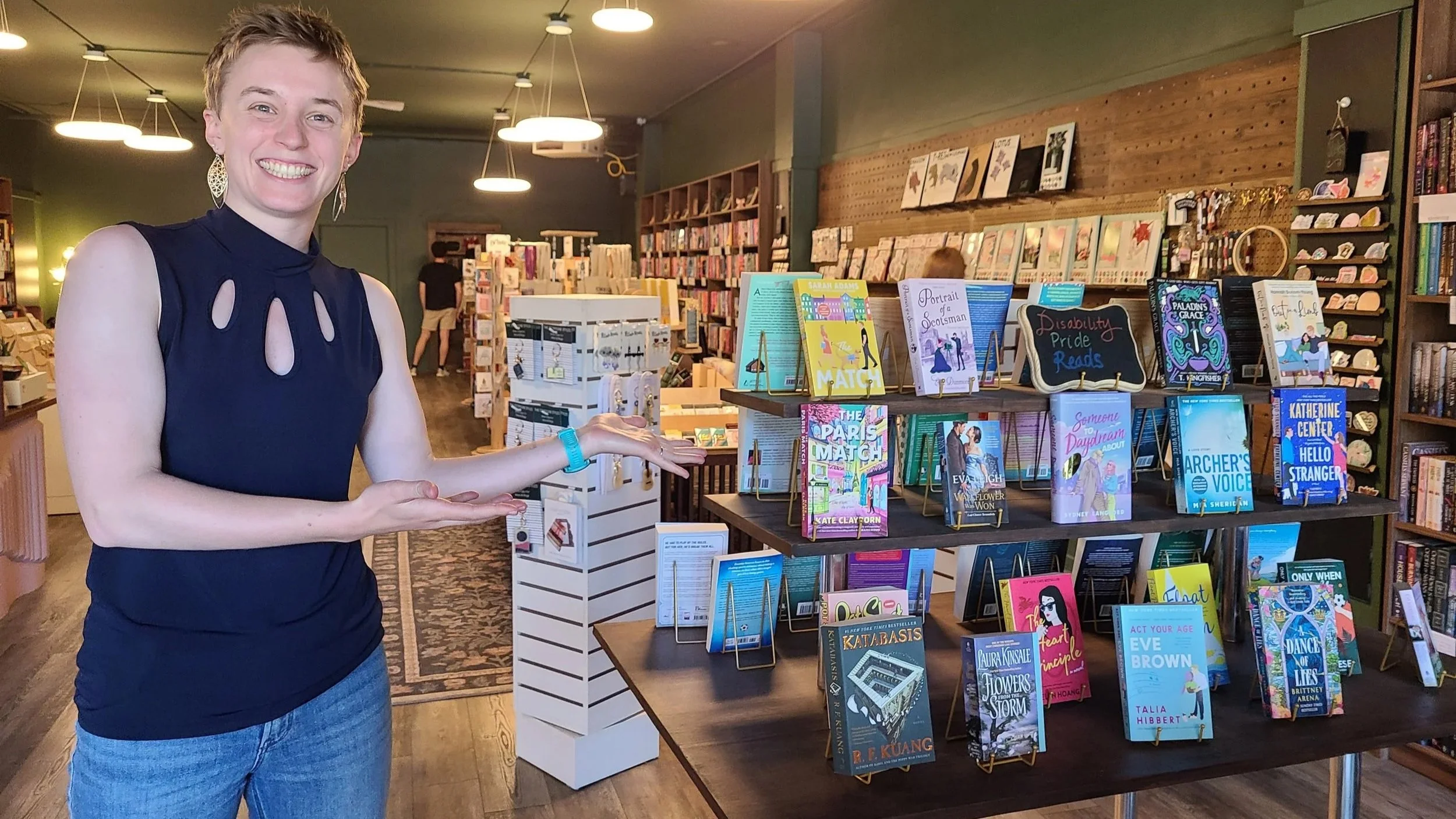
Earlier this month, bookseller Audrey posed with Swoon City’s Disability Pride Month display
From disabled family members and friends, I knew about existing struggles such as the “marriage penalty” and often not being able to work or have money in their bank accounts because of the risk of losing essential health benefits. One thing I learned in crowdsourcing reading recommendations for this though is that fewer people seem to have top-of-mind books with disability representation than a lot of other identity categories. This despite (or perhaps because?) most of us without disabilities now can be considered temporarily non-disabled. I also found that recommendations were more concentrated in nonfiction – primarily memoir and essay - and in romance, and not so many other fiction genres.
On the nonfiction side, Senior Manager of Food Access, Ysabel Diaz, recommends Disability Visibility, edited by Alice Wong who died last year. Ysa shares, “I’d recommend Disability Visibility as it is a collection of stories that gives first-hand experience and perspective to the ways the world is set up for certain types of abilities and leaves a lot of people outside of that framework. It left me with more understanding of how I could be more thoughtful and supportive to people in my life.”
I recently finished reading Care Work: Dreaming Disability Justice by writer, organizer, and performance artist Leah Lakshmi Piepzna-Samarasinha. Through extensive discussion of collective care and reciprocity, Piepzna-Samarasinha centers disabled queer and trans Black, Indigenous, and people of color. She highlights the unique skills of disabled individuals with other marginalized identities in solving problems and providing care to each other. “Everything doesn’t have to be fifty-fifty all the time. I think that’s especially important for folks who need a lot of care to survive, who may not be able to offer a ton back all the time. But I would argue for a general bend towards of offering something back even just a thank-you, a ‘Hey, I see the work you just put in’ or a ‘I’m too sick to do anything right now but I can offer this when I can’…Reciprocity of care labor is also a disabled practice. In disabled communities, we talk about the idea that we can still offer reciprocity to each other, even if we can’t offer the exact type of care back.” I learned a lot from this book and it challenged me to think about community-building in new ways.
One of the books I’m currently reading, I Identify as Blind by the musician Lachi takes what feels like a more lighthearted approach without ignoring the backdrop of serious issues and challenges. Like Piepzna-Samarasinha, Lachi notes the importance of following disabled leadership, writing “Why this book, and why now? Because there’s never been a time when humanity has confronted the commandment ‘adapt or die’ with more urgency. From climate change to economic inequality, from pandemics to artificial intelligence, the global shit show is already in act two…Who better to teach humanity how to adapt and thrive than people for whom adaptation is our operating system, and for whom creative problem solving and perseverance are our table stakes?”
For a fun, sweet, and swoon worthy read, I recommend Always Only You by Chloe Liese. Part of a series of related standalone romances, the author notes it was a little scary to write a book where the female main character’s disabilities – rheumatoid arthritis and autism – aligned closely with her own. I’m glad she did, I loved the well-rounded characters, both the central couple and their families and friends. I recommend this one if you enjoy romances with lots of pining, some spice, and complicated, loving families.
Ready to explore more recommendations? Check out the following resource lists and be sure to share your own favorites with me at gypsyw@ballardfoodbank.org!
Seattle Public Library: Adult Books for Disability Pride
King County Library System: Disability Pride Month Reads
Library Journal: Disability Pride Month 2026 | A Reading List
Boston Public Library: Disabled, Not Unable 2026: 75 Books for Children, Teens, & Adults